
When You’re the One Driving Mom or Dad to Every Appointment
Most family caregivers don’t plan on becoming one. It happens slowly: a fall, a hospital stay, a new diagnosis, an inhaler that needs refilling, a cardiologist visit on the other side of Dallas. Suddenly, your calendar isn’t just yours anymore, and a Tuesday morning means navigating a parking garage with a parent who shouldn’t be walking that far.
If that sounds familiar, you are exactly the audience this guide is written for.
Geriatric virtual care provider-led healthcare delivered to aging parents from the comfort of their home through secure video and phone visits has quietly become one of the most useful tools available to family caregivers in Texas and Oklahoma. It doesn’t replace every in-person visit, but it solves the visits that shouldn’t have to be in person in the first place: medication reviews, blood pressure follow-ups, post-hospital check-ins, chronic condition management, and the dozens of small questions that pile up between specialist appointments.
This is a practical guide to what virtual geriatric care looks like, when it’s appropriate, how to set it up for a parent who isn’t “tech-savvy,” and how Advanced Practice Health Connect (APHC) supports families across Dallas, Fort Worth, Plano, Frisco, Arlington, Irving, McKinney, Tulsa, Oklahoma City, and surrounding communities.
What Geriatric Virtual Care Actually Looks Like
A geriatric virtual visit is a structured appointment between an aging adult and a board-certified advanced practice provider, delivered through secure video or phone. The provider can:
- Review symptoms, vitals, and recent home readings
- Adjust medications and send prescriptions to your parents’ pharmacy
- Order labs at a location near home
- Coordinate with cardiologists, neurologists, and other specialists
- Review fall risk, cognitive changes, and functional status
- Check in after a hospital discharge or ER visit
- Address acute concerns like a cough, urinary symptoms, or dizziness
- Recommend escalation to in-person care when truly needed
The visits typically run 20–30 minutes longer than a rushed clinic visit, with no waiting room, no parking, and no exposure to whoever is sitting in the next chair, coughing.
Seven Signs Your Aging Parent Would Benefit From Virtual Care
If three or more of these describe your parents’ situation, virtual care is likely a strong fit:
- They live in Texas or Oklahoma, and you (the caregiver) live in a different city or simply work full-time
- Getting to and from the doctor’s office is becoming physically difficult
- They have two or more chronic conditions being managed by different providers
- They’ve been hospitalized or visited the ER in the last 12 months
- They take five or more daily medications
- They have hearing, mobility, or cognitive challenges that make in-person visits exhausting
- They miss or reschedule appointments because of transportation
None of these is a personal failure. They’re predictable realities of aging, and they’re exactly what virtual care was designed for.
What Geriatric Conditions Can Be Managed Virtually?
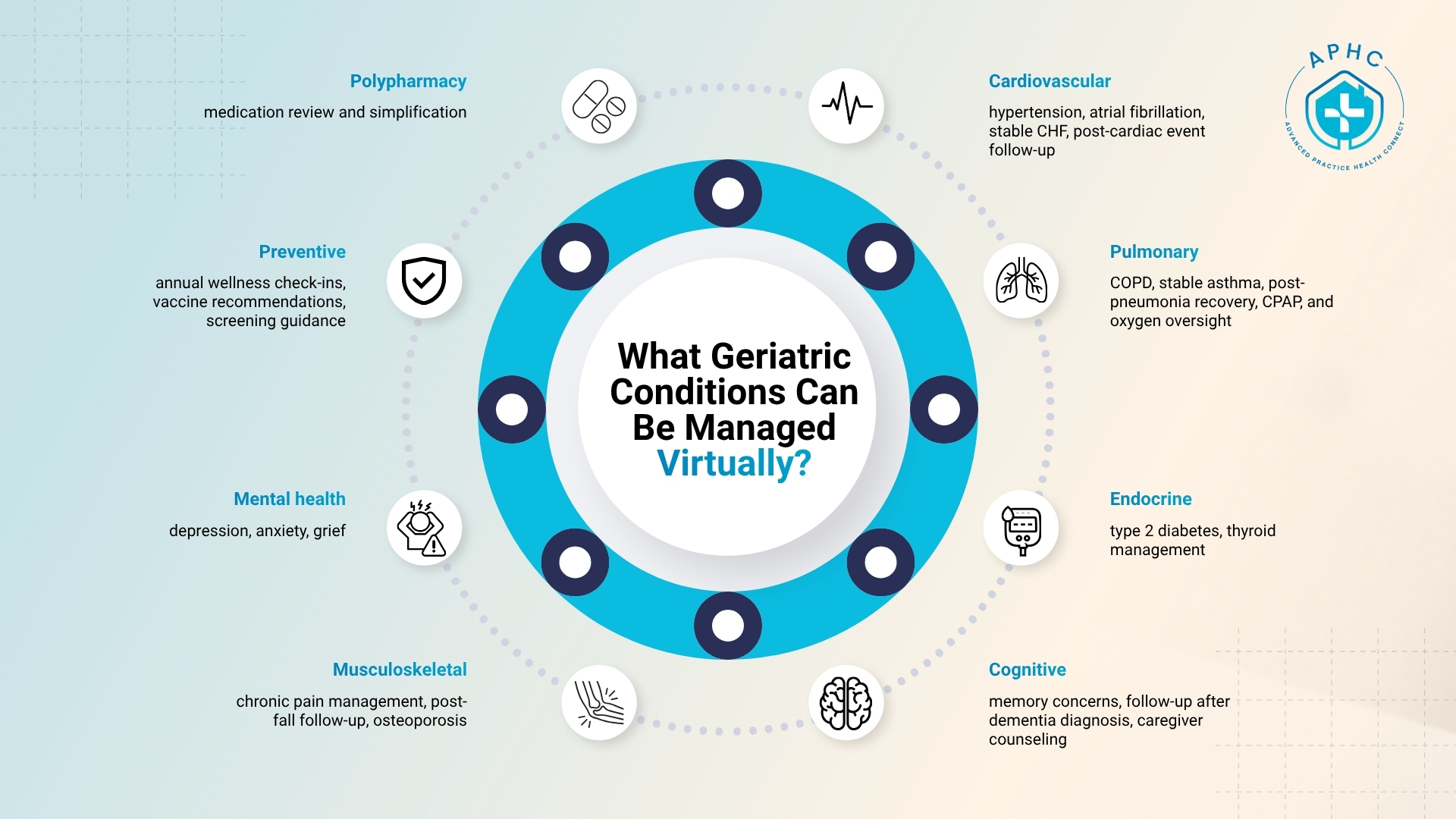
Most non-emergency geriatric care can be safely managed through telehealth, especially when paired with home health support. Conditions that virtual care handles well include:
- Cardiovascular: hypertension, atrial fibrillation, stable CHF, post-cardiac event follow-up
- Pulmonary: COPD, stable asthma, post-pneumonia recovery, CPAP, and oxygen oversight
- Endocrine: type 2 diabetes, thyroid management
- Cognitive: memory concerns, follow-up after dementia diagnosis, caregiver counseling
- Musculoskeletal: chronic pain management, post-fall follow-up, osteoporosis
- Mental health: depression, anxiety, grief
- Preventive: annual wellness check-ins, vaccine recommendations, screening guidance
- Polypharmacy: medication review and simplification
Things that still need an in-person visit, such as acute chest pain, suspected stroke, significant injury, severe shortness of breath, should still be handled by 911 or the nearest ER. Virtual care complements emergency and in-person care; it doesn’t try to replace them.
Setting Up Virtual Care for a Parent Who Isn’t “Tech-Savvy”
This is the question every adult child asks first, and the honest answer is: it’s much easier than you’d think.
You only need three things:
- A smartphone, tablet, or laptop with a camera and internet
- A quiet, well-lit spot in the home
- A list of current medications (the bottles work fine)
A few caregiver tips that make visits go smoothly:
- Be there for the first visit: Even a brief presence helps your parent feel comfortable and helps the provider get oriented to the household.
- Have the medication bottles in front of you: Don’t trust memory or old lists.
- Write down two or three top concerns ahead of time: Visits with a focused agenda always go better.
- Use the speakerphone if hearing is an issue, or a Bluetooth hearing aid that pairs with the device.
- Keep recent vitals nearby: home blood pressure readings, glucose logs, and recent weight if relevant.
- Don’t worry about the technology: The APHC team walks every patient through it the first time.
For parents with significant cognitive challenges, virtual visits can absolutely still work; they just work best when a family member or in-home caregiver is present to help bridge communication.
How Virtual Care Works Alongside In-Person Care
Virtual geriatric care doesn’t ask your parent to leave their current doctor. It works best when it sits alongside the rest of their care:
- The PCP stays the PCP
- Specialists stay specialists
- The home health agency, if there is one, keeps doing what it does
- Virtual providers fill in the gaps in between visits, the medication questions, the post-hospital check-ins, and the chronic condition oversight that needs to happen monthly, not annually
APHC actively coordinates with your parents’ existing care team. Notes, medication changes, and clinical updates flow to the relevant providers so nothing falls through the cracks.
A Word About Insurance and Cost
Medicare, Medicare Advantage, and most commercial insurance plans cover telehealth visits with qualified providers and have since pandemic-era expansions made permanent for many use cases. Specific coverage varies by plan, so the APHC team verifies benefits before your parent’s first visit. There are no surprises, and most patients find their out-of-pocket costs are equal to or less than a traditional clinic visit.
For caregivers managing the financial side of an aging parent’s life, this is one less spreadsheet column to worry about.
Why Texas and Oklahoma Families Choose APHC for an Aging Parent
- Board-certified advanced practice providers experienced with older adults
- 24/7 access for urgent questions
- Bilingual care coordination for Spanish-speaking households
- Same-day and same-week telehealth visits are available Monday through Friday
- Real coordination with hospitals, home health agencies, and specialists
- One direct phone line, 866-367-7031, that connects you to a real person
We serve families across the Dallas–Fort Worth metroplex, the broader state of Texas, and communities throughout Oklahoma.
Ready to Make Your Parents’ Healthcare Easier?
If you’ve been the https://aphcmed.com/contact-us/family member quietly managing parking, paperwork, prescriptions, and pickup times, this is the help you’ve been looking for. A short conversation with the APHC team can tell you whether virtual geriatric care is the right fit for your parent and what their first visit would look like.
Call APHC at 866-367-7031 or contact our team online to get started.